
Inclusion Insights: How Special Olympics Helps Young Children Thrive
Special Olympics is a global movement that advances inclusion through sport, health, education, and community programs for people with intellectual and developmental disabilities (IDD). While many people recognize Special Olympics for its sports programming, the organization also works to improve access to healthcare, promote healthy development, and support children and families from an early age.
Since 1997, Special Olympics Healthy Athletes has offered free health screenings for individuals with IDD over the age of 8. These screenings also provide training to healthcare professionals and students to deliver higher-quality, inclusive care for people with intellectual disabilities.
Recognizing the unique healthcare needs of young children and that early childhood is a critical period for intervention, Special Olympics later developed Healthy Young Athletes (HYA), a holistic pediatric screening for children 2 – 7 years old, with and without intellectual and developmental disabilities. Healthy Young Athletes provides comprehensive screenings across multiple areas of health and development, including vision, hearing, dental health, physical wellness, and developmental milestones. The program emphasizes the importance of early identification, family education, and timely referrals to community resources and healthcare providers. HYA can be implemented across schools and in community settings. Following the screening, if a child needs a more comprehensive evaluation or community support, the local Special Olympics Program works to connect their family with local resources and clinical providers so the child can get the help they need. Healthy Young Athletes provides an opportunity to educate and empower parents and caregivers to better support their child’s growth and development, and helps detect delays and undiagnosed comorbidities that commonly occur in children with IDD.
By connecting families to follow-up care and strengthening the capacity of healthcare providers to serve children with IDD, HYA works to bridge gap in access to developmental screenings and specialized pediatric care that can be significantly limited in many areas.
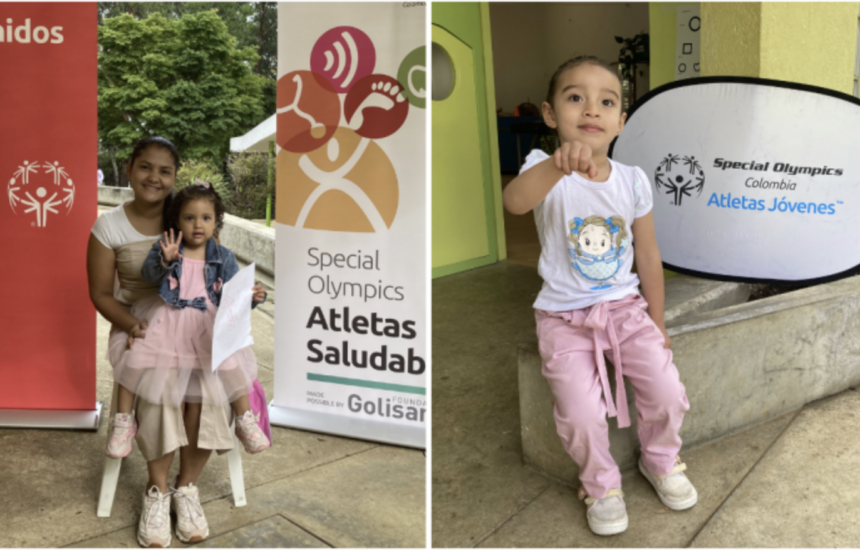
In Medellín, Colombia, a local preschool held its first-ever Healthy Young Athletes screening, marking a milestone for the Special Olympics Colombia Program. Among the children screened were Emma Chavarria, age 2, and Saray Pérez Bedoya, age 3, who participate in Special Olympics Young Athletes, an inclusive early childhood play program for children with and without IDD.
Emma and Saray were thoughtfully selected by the preschool’s special educator and psychologist, who prioritized students showing early signs of developmental concerns that had not been formally discussed with their families. While neither Emma nor Saray have received a formal IDD diagnosis, both receive special education and psychological support to address delays in communication and language, thinking, reasoning, and problem-solving.
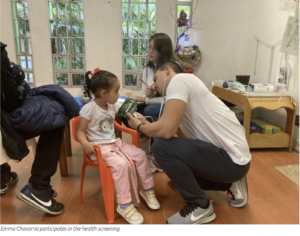
Accessing pediatric and multidisciplinary care has become a challenge due to the ongoing transition surrounding Colombia’s health reform. This has resulted in long wait times and delays for appointments and authorizing evaluations, often leaving children and their families without timely care. During the Healthy Young Athletes screening at their school, both Emma and Saray received physical, vision, hearing, and dental screenings as well as developmental screenings of their language and communication, fine and gross motor skills, cognitive abilities, and social-emotional development.
Emma’s screening revealed signs of an overactive bladder, one of many health issues that may be overlooked in children with IDD. Emma and her family received recommendations for healthy urination habits and a non-urgent referral for follow-up care to help address the condition and improve Emma’s overall quality of life.
As for Saray, while moving through the different screening stations, it was discovered that she had difficulty hearing. Children with developmental disabilities are more likely to have reduced hearing than those without developmental disabilities. Saray’s screening also indicated a possible language disorder and gastroesophageal (acid) reflux, conditions that could lead to difficulties in the future if left untreated. Saray was referred for speech therapy, pediatric care, and an urgent audiology evaluation.
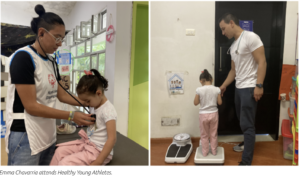 While each child’s needs were different, both experiences highlight the same truth: early detection and follow-up care open the door to identifying and treating children at-risk for comorbidities that commonly occur in children with IDD. Through Healthy Young Athletes, both Emma and Saray received specialized screenings that investigated their needs across many areas of health and development. Participating in the screening helped empower their families and caregivers to better support their child’s growth and development by connecting them to community resources and local healthcare providers.
Healthy Young Athletes builds pathways to care that help children with IDD thrive by creating a bridge to essential community services and local healthcare providers trained to care for their unique needs. For Emma, Saray, and the many other children who participated in the health screening, the impact of early detection can help identify health concerns and lead to better long-term outcomes.
Special Olympics understands the importance of supporting children and families as early as possible and has a vast suite of resources and programming that start supporting families and children from the moment they receive an IDD diagnosis. To get connected with your local Program, access health information, and build a plan of care for your child, contact Special Olympics at ecd@specialolympics.org
Explore CE International's consulting services.