
Childhood Education Innovations
Celebrating 100+ Years of Publication!
Do you want to expand your knowledge of early childhood care and education by learning about practices and initiatives from around the world? Subscribe today and receive Childhood Education Innovations magazine, the premier international magazine bringing you cutting-edge innovations and global perspectives in children’s care and education.
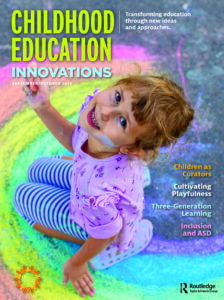
Childhood Education Innovations provides a unique, stimulating breadth of information about educational practices, approaches, programs, and initiatives from around the world.
Articles explore solutions to specific challenges affecting schools, teachers, and learners and showcase innovations being developed and implemented to address those challenges. Readers will find inspiration for transforming education to better serve children and their communities.
Published 6 times a year, Childhood Education Innovations provides a window into the work being done to bring quality, equitable education to all children and with a reasonable price of only $50 per year (online).
Childhood Education Innovations stands alongside our research journal — the Journal of Research in Childhood Education — as one of our signature publications.
Sneak Peek of the November/December 2026 Issue ArchivesSubmission Guidelines
September/October 2026 Contents:
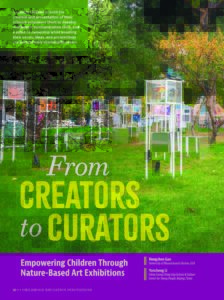 “From Creators to Curators: Empower Children Through Nature-Based Art Exhibitions”
What happens when children are trusted not only to create art, but also to decide how the world will experience it? In this student-led “Sky Blind Box” project, young artists became curators, making thoughtful choices about space, light, perspective, and audience while developing confidence, leadership, collaboration, and creative agency. Their outdoor exhibition demonstrates that presenting art can be as valuable a learning experience as making it, giving children opportunities to negotiate, problem-solve, consider others’ perspectives, and take genuine ownership of their ideas. By shifting educators from directors to facilitators, student curation transforms the exhibition from a final showcase into a dynamic extension of learning—one in which children’s voices, decisions, and capabilities become vividly visible.
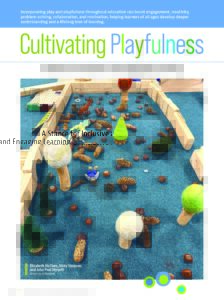
“Cultivating Playfulness: A Stance for Inclusive and Engaging Learning”
Playfulness can be a powerful way of teaching at every stage of primary education. Scotland’s Playfulness Project shows how nine schools are reimagining playfulness as a pedagogical stance that brings joy, curiosity, agency, and meaningful engagement into learning across the curriculum. As teachers shift from simply delivering instruction to becoming facilitators, co-players, observers, and designers, children are showing greater confidence, creativity, collaboration, perseverance, and wellbeing. Just as importantly, educators are gaining the confidence to balance curriculum expectations with children’s autonomy and diverse needs. Rather than offering another program to implement, the project demonstrates how a playful mindset can transform classroom practice and school culture—creating inclusive environments where rigorous learning and joyful learning are not competing priorities, but partners.
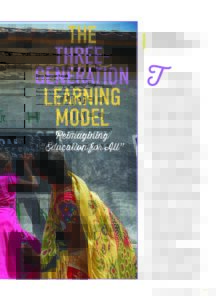
“The Three-Generation Learning Model: Reimagining Education for All”
The Three-Generation Learning Model reimagines education as a shared family and community experience in which children, parents, and grandparents become both learners and teachers. Through “reverse learning,” children carry knowledge beyond school walls—into homes, courtyards, and streets—while adults contribute practical experience, culture, and wisdom. Designed particularly for marginalized communities where formal education may be inaccessible, the model relies on local relationships, everyday spaces, and community participation rather than costly infrastructure. In doing so, it seeks not only to expand literacy and learning, but also to strengthen family relationships, empower women and children, challenge practices such as child labor and early marriage, and build a culture in which education becomes a collective pathway toward dignity, opportunity, and lasting social change.
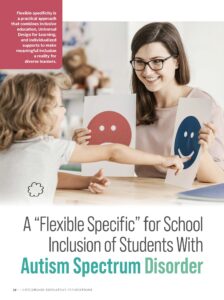
“A ‘Flexible Specific’ for School Inclusion of Students With Autism Spectrum Disorder”
For autistic students, simply being present in a mainstream classroom is not enough; meaningful inclusion requires educators to recognize individual strengths and needs and provide flexible, targeted support. This article explores how Universal Design for Learning and “flexible specificity” can bridge rights-based inclusion with individualized strategies, allowing supports developed for particular learners to become resources that may benefit many. With knowledgeable teachers, appropriate accommodations, strong school leadership, and collaboration with families and specialists, schools can create environments where differences are not stigmatized but expected and valued. The result is a richer vision of inclusion—one in which every learner has genuine opportunities to participate, belong, and thrive.
“The Stewardship of Sovereignty: Reimagining the 40-Year Horizon in Global Education”
What if the true measure of mentorship is not what young people achieve while we guide them, but what they are able to accomplish long after we are gone? This article challenges educators and mentors to move beyond short-term success and cultivate a lasting legacy by transferring genuine agency, responsibility, and decision-making power to youth. Through three pillars—decisional sovereignty, an “innovation engine” combining technical rigor with imagination, and a “failure buffer” that allows young people to learn from setbacks—it offers a framework for developing autonomous, resilient leaders. The ultimate goal is a provocative one: mentors should work toward their own obsolescence, creating not dependent participants but confident successors prepared to take ownership, navigate uncertainty, and carry the mission forward for generations.
“Leading Through Subversion: Early Childhood Educators in Ghana”
Leadership must take a unique form when formal policies collide with scarce resources, cultural expectations, and the everyday needs of children and families. Through the experiences of early childhood Headteachers in Ghana, this article reveals a form of “subversive leadership” grounded not in resistance, but in adaptation, relationships, care, and ethical judgment. These leaders continually negotiate between bureaucratic demands and community realities, performing essential work that often remains invisible in official measures of leadership effectiveness. Their experiences challenge one-size-fits-all, managerial models and invite a broader understanding of leadership as something shaped by context and enacted through human relationships. By recognizing this often-unseen expertise, education systems can develop more flexible, culturally responsive approaches to leadership—lessons that resonate far beyond Ghana.
“How Schools Can Use AI to Build Curious, Ethical, and Critical Young Learners”
This article presents AI literacy as an educational innovation that moves beyond digital skills to cultivate critical thinking, curiosity, ethical judgment, and responsible decision-making. Through practical classroom activities—such as comparing AI-generated summaries with original texts, verifying AI responses, examining bias, and reflecting on when to accept or reject AI suggestions—children become active thinkers rather than passive consumers of technology. Because these practices can be integrated across subjects without expensive tools or infrastructure, AI literacy offers an adaptable and sustainable approach for schools. Ultimately, the goal is not to help children keep pace with technology, but to ensure they develop the distinctly human capacities needed to navigate an AI-rich world with confidence, responsibility, and discernment.
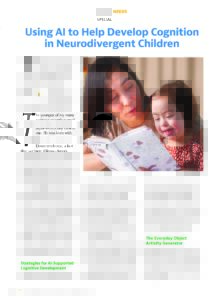
“Using AI to Help Develop Cognition in Neurodivergent Children”
Drawing on one family’s experience supporting a baby with Down syndrome, this article explores practical ways AI can serve as a creative partner at home—generating learning games from ordinary objects, personalizing stories, translating therapy goals into playful routines, troubleshooting activities, and making expert guidance easier to understand. AI is not presented as a substitute for parents, therapists, or pediatricians, but as a tool that can help caregivers feel more confident and resourceful. Ultimately, the most powerful ingredients in early development remain deeply human: presence, patience, repetition, responsiveness, and the loving interactions that help children discover what they can do.
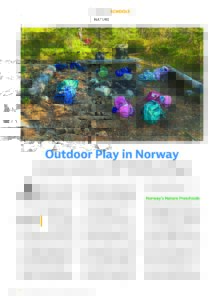
“Outdoor Play in Norway: Lessons Learned at the Friluftsbarnehage”
Norway’s nature preschools offer a compelling vision of childhood rooted in friluftsliv, or “open-air living,” where children learn through freely chosen play, exploration, manageable risk, and direct encounters with the natural world. Climbing trees, navigating rugged terrain, dressing themselves, gathering berries, and inventing games with sticks, stones, and mud help children develop physical skills, creativity, confidence, independence, self-regulation, and problem-solving. Supported by attentive adults who supervise without unnecessarily controlling, children are trusted to test their abilities and take responsibility for themselves. Just as importantly, sustained immersion in nature nurtures curiosity, wonder, and environmental stewardship—demonstrating how outdoor play can lay a powerful foundation for children’s lifelong well-being, resilience, and participation in the world.
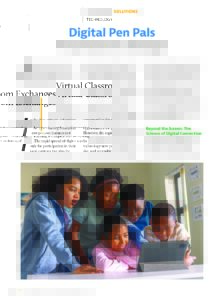
“Digital Pen Pals: Virtual Classroom Exchanges”
Virtual classroom exchanges—or “digital pen pal” programs—bring young learners together with peers in other communities and countries for shared stories, songs, conversations, and collaborative projects. Designed thoughtfully, these exchanges can strengthen language and literacy, empathy, intercultural understanding, social-emotional skills, digital literacy, confidence, and global competence. Rather than using technology for passive consumption, children become active communicators, collaborators, and “knowledge bearers” who share their own cultures while discovering that others may experience the world differently. With developmentally appropriate activities, careful facilitation, and equitable access, virtual exchanges can transform technology into a bridge for curiosity, friendship, and global citizenship—helping even the youngest learners begin to see themselves as participants in an interconnected world.
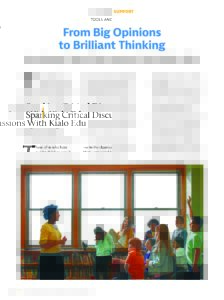
“From Big Opinions to Brilliant Thinking: Sparking Critical Discussions With Kialo Edu”
Educators can turn children’s strong opinions into thoughtful, evidence-based reasoning. Kialo Edu offers a playful yet structured way to transform lively classroom conversations into opportunities for deeper thinking. Through age-appropriate discussion prompts ranging from privacy and zoos to travel and superpowers, students learn to make claims, support their ideas, consider competing perspectives, and disagree respectfully. A visual argument-mapping format helps learners see connections among ideas, while features such as anonymous participation, small-group discussions, teacher feedback, and hundreds of adaptable templates make the platform accessible across subjects and learning styles. By channeling children’s natural enthusiasm for sharing what they think into exploring why they think it, Kialo Edu helps make critical thinking an engaging part of everyday learning—and builds habits of reasoning and dialogue that can last a lifetime.