
Journal of Research in Childhood Education
Educating the Educators
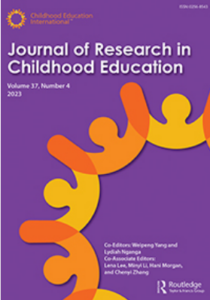 From empirical research projects to small-case studies carried out in naturalistic settings, such as schools and community centers, the Journal of Research in Childhood Education tracks data across cultures and study research design. Published 4 times a year, JRCE presents education research on a wide range of ideas, including theory articles and studies on all scales.
Table of Contents
Volume 40, Issue 4
Effects of Remote Parental Interventions on Shared Reading Practices: A Systematic Review
Games, Physical Activities, and Outdoor Excursions as Powerful Knowledge in Swedish School-Age Educare open access
Investigating the Nature of Interaction in Early Childhood Pedagogical Documentation Contexts
The Impact of Coding Intervention on Preschool Children’s Coding and Computational Thinking Skills
Children’s Affective Experiences During Recess: Who Changes the Most Across a School Year?
Digital Technology in Kindergarten: Kindergarten Teachers’ Practices and Their Effects on Children
Homework as an Opportunity for Joint Attention in Middle Childhood open access
Reimagining Early Childhood Assessment Practices in a Data-Driven World
Translanguaging and Storytelling in the Author’s Chair for Young Bilingual Immigrant Children
The Impact of Trauma on PK-1st-Graders: Educator Perspectives
Meeting Children in the Margins: A Grounded Theory Study of Montessori Education’s Global Reach open access
Expanding Autism Knowledge and Access in Early Childhood Education Community-Based Settings
Table of Contents • Special Issue (Open Access)
Volume 38, Issue 1 Supplement
Parent Training and Child Development at Low Cost? Evidence From a Randomized Field Experiment in Mexico
by Sergio Cárdenas, David K. Evans, and Peter Holland
This article presents evidence on the effects of a low-cost, group-based ECE program in rural communities in six Mexican states.
Read the article
The Virtual Irie Homes Toolbox: Adaptation and Remote Delivery of an Early Childhood, Violence Prevention, Parenting Program in Jamaica
by Taja Francis, Lelys Dinarte-Diaz, Shawn Powers, and Helen Baker-Henningham
This article examines the impact of a 10-week program focused on early childhood, violence prevention, and parenting in Jamaica.
Read the article
Impact of COVID-19 on Young Children and Families in Jamaica
by Maureen Samms-Vaughan, Sydonnie Pellington, and Rosan Reynolds-Salmon
This article outlines impacts of the COVID-19 pandemic on young children and families in Jamaica. Some key findings include financial difficulties, reduced access to education, increased parenting demands, and increased levels of corporal punishment.
Read the article
Pre-Primary Education and School Readiness Amid the COVID-19 Pandemic: Evidence From Ethiopia
by Janice Kim, Mesele Araya, Pauline Rose, and Tassew Woldehanna
This article investigates the impact of the COVID-19 pandemic on pre-primary-age children’s school readiness in Ethiopia.
Read the article
Parental Engagement in Children’s Pre-Primary Education in Marginalized Communities in Tanzania Before and During the COVID-19 Era
by Richard Shukia and Stansilaus Marobo
This study examined parental engagement in their children’s pre-primary education in socioeconomically deprived settings in Tanzania. Finding the potential for greater learning loss during the pandemic among children in this group, it points to the importance of additional support for these parents and children.
Read the article
Using Early Childhood Data and Measurement to Leverage Change: Are We Making Progress?
by Abbie Raikes
As countries make investments in early childhood care and education systems, data and measurement play a critical role in outlining strengths and areas for improvement. This article focuses on the role of measurement in ECCE and key issues facing ECCE data and measurement.
Read the article
Parental/Caregiver Engagement in Early Learning Systems: Findings from Early Learning Partnership (ELP) COVID-19 Research in Pakistan and Ethiopia
by Monazza Aslam, Saba Saeed, Belay Hagos, and Baela Jamil
This study explores the degree of engagement of parents/caregivers of preschool children in Ethiopia and Pakistan and the modes of learning they used for home learning during COVID-19 school closures.
Read the article
Pashe Achhi: A Low-Tech Model of Learning and Psychosocial Support for Children and Caregivers
by Mohammad Safayet Khan, Erum Mariam, Nasrin Akter Akhi, Esrat Jahan, and Sakila Yesmin
Pashe Achhi is a telecommunication model that emerged out of the COVID-19 pandemic in Bangladesh to provide support for children ages 0-5 and their caregivers through mobile-to-mobile calls. This article examined the impact of the intervention.
Read the article
Understanding Access to and Learning Outcomes from ECE Among Refugees and Non-Refugee Populations in Uganda: A Cross-Cohort Comparison
by Bea Simpson, Mary Goretti Nakabugo, and Ricardo Sabates
In Uganda, access to early childhood education is limited for children from disadvantaged families, particularly refugees. This article examines the level of access to and learning outcomes from ECE among refugees in Uganda over time.
Read the article
Ten Years of Early Childhood Education (ECE) in Punjab (Pakistan): What Have We Learned?
by Amna Ansari, Tazeen Fasih, and Ella Humphry
This article explores early childhood education administration across two accountability relationships in Pakistan’s most populous province, Punjab. The results indicate a need to strengthen the province’s early learning system and improve the flow of accountability through effective delegation, finance, information, and motivation.
Read the article
Donor Coordination and Evidence Uptake in Early Childhood Education Policy
by Rachel Hinton, Holly Scott, Shawn Powers, and Salim Salamah
Although there has been a recent increase in investment in ECE, the share of official development assistance for ECE remains extremely low. This article provides considerations for researchers, practitioners, and policymakers interested in increasing donor finance for ECE.
Read the article
Need Support Putting Your Ideas Into Action?
Schedule Your Free Consultation